Guide
XCMG XE700GK 70-Tonne Excavator: Specs, Configurations & Quote Price
Why published weights for the XE700GK differ, how bucket, arm and undercarriage choices move digging force and price, and what a written specification should contain.
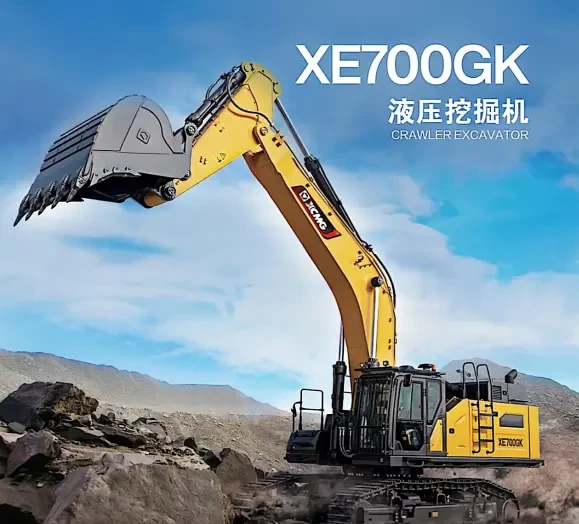
The XCMG XE700GK is a 70-tonne class crawler excavator designed for hard-rock work: quarry face loading, overburden removal, and primary breaking in metal and aggregate mines. Buyers who compare listings for this model quickly notice that the same machine is quoted at 69.8, 71, and 73 tonnes depending on the source. That is not a data error. The XE700GK is built to order across several configurations, and the specification sheet changes with the bucket, undercarriage, and emission package selected.
What follows is a reading of the published figures, with the variables that matter when the machine is priced.
Power: a 15-litre engine tuned for low-speed torque
The engine is a XCMG-customized Cummins M15, also designated QSM15, a 14.5-litre six-cylinder unit with electronic injection, turbocharging, and air-to-air intercooling. Rated output is 563 kW at 2,000 rpm, with maximum torque of 2,900 Nm available from 1,200 rpm. The torque curve is deliberately flat at the bottom end, which is what allows a loaded bucket to break out of tight, abrasive material without stalling the hydraulic system.
The engine is rated to China IV off-road emission standards without a urea injection system or diesel particulate aftertreatment, according to XCMG’s product documentation. That matters in two ways: there is no DEF tank to fill, and there is one less aftertreatment component to service in a dusty environment. Export versions sold outside China may carry a different emission package, so the engine label on a specific unit should be checked rather than assumed.
Published dealer figures put fuel consumption at roughly 42 to 52 litres per hour under mixed load. That range is wide because consumption tracks duty cycle more closely than it tracks the engine rating. A machine cycling rock at full bucket load can sit at the top of it; a machine stripping overburden will not.
Hydraulics: flow and pressure set the cycle speed
The hydraulic system uses two electronically controlled piston pumps, rated at 434 litres per minute each in some specifications and 462 litres per minute in others. Main relief pressure is 34.3 to 37 MPa, travel circuit pressure 34.3 MPa, swing circuit pressure 32 MPa, and pilot pressure 3.9 MPa.
Component sourcing varies by build. Published part lists show Kawasaki K7V280 main pumps and KMX36NA main valves on one version, with KYB travel motors and a Comer travel reducer; other market versions list Hengli pumps and valves. The practical difference for a buyer is parts availability in the destination country, not digging performance.
Digging force is the number most often compared. The bucket figure ranges from 368 kN to 386 kN across published sheets, and the arm figure from 310 kN to 328 kN. Maximum tractive force is 463 to 469 kN. The spread comes from bucket type and arm length, not from a variance in the base machine.
Working envelope: what the machine can reach
With the standard 7,100 mm boom and 2,900 mm arm, the XE700GK reaches a maximum digging radius of 12,160 mm and a maximum digging depth of 7,255 mm. Maximum digging height is 11,665 mm and maximum dump height 7,610 mm. A shorter 2,550 mm arm is offered for applications that prioritise breakout force over reach.
Transport dimensions are 12,900 mm long and, depending on track configuration, 4,005 mm wide with the walkway fitted. Track shoe width is listed at 600 mm or 650 mm. Ground pressure sits at 101 to 105 kPa, and gradeability is 35 degrees. Travel speed is 4.5 km/h in high range and 2.7 km/h in low range, with swing speed at 7.2 rpm.
The undercarriage is the part that separates a mining build from a general construction build. The standard heavy-duty chain uses a 228 mm pitch, with a 260 mm pitch available, and the track frame is a 70-tonne class welded structure with extended gauge and wheelbase for stability under a heavy breaker or a large rock bucket.
Why the published numbers do not always match
XCMG’s own Chinese product page lists an operating weight of 71,000 kg with a 4.5 m³ bucket. The factory technical specification sheet gives a weight range of 68,500 to 71,500 kg with bucket capacity from 4.0 to 5.0 m³. Overseas distributor pages list 69,800 kg or 73,000 kg. All of these can be correct simultaneously.
Weight moves with the counterweight package, the undercarriage variant, the arm length, and the bucket. Bucket capacity moves with the material being handled: a 4.0 m³ general-purpose bucket, a 4.5 m³ rock bucket, and a 5.0 m³ reinforced bucket are three different tools on the same carrier. A quote that lists a single weight without stating the configuration behind it is not yet a specification.
The same logic applies to digging force. A 368 kN figure usually travels with a standard rock bucket and the long arm; a 386 kN figure appears with a different bucket and arm combination. Comparing those two numbers as if they described the same machine leads to the wrong conclusion about which unit fits a site.
Configuration choices that change the price
Four decisions drive most of the price difference between two XE700GK units. The first is bucket and arm pairing, which sets the balance between reach and breakout force. The second is undercarriage specification, including track pitch and shoe width, which must match ground conditions and transport limits. The third is the emission package, since a China IV unit and an export-market unit are not interchangeable for registration purposes. The fourth is attachment readiness: hammer piping, quick coupler provision, and the hydraulic flow settings needed for a breaker.
Cab and safety options also appear on quotation sheets. The XE700GK is offered with a FOPS/OPG-rated cab, a 10.1-inch touchscreen display, a rear camera, LED work lights, and an optional fixed front window for high-dust sites. None of these change the machine’s working envelope, but they change the delivered price and the resale specification.
Getting a quote that matches the machine
A specification sheet describes a family of builds. A purchase decision needs one build, confirmed in writing, with the serial number and the fitted options attached. That is the difference between a brochure figure and a machine that arrives at a port matching what was ordered.
SHUNFA Machinery has handled construction equipment export from China for 35 years and ships to more than 100 countries. Our team can confirm the current XE700GK configuration options, match the specification to the working conditions at the destination site, and return a quotation with the exact configuration, emission standard, and delivery terms stated. Every unit we handle is inspected before shipment, with reports and photographs provided before payment, and SGS, CE, and EPA documentation arranged where the destination market requires it.
Send the jobsite conditions, the material to be handled, and the destination port to our team, and we will respond with a priced specification within 24 hours. Contact us by phone or WhatsApp at +86 13764468035, or by email at shunfa@usedexcavator.shop.
Request a quote for this machine
Send the destination port, bucket or breaker configuration and preferred year range. We reply within 24 hours with matching units, photos and a delivered price.