Guide
XCMG XE310GA 31-Tonne Excavator: Specs, Configurations and Quote Price
Published XE310GA figures for the China IV and export builds, what the working envelope allows, and what to verify on a specific used unit.
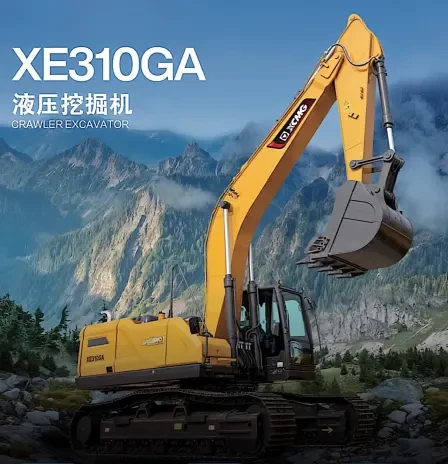
The 30-tonne crawler excavator is the workhorse class of most earthmoving fleets. It is heavy enough to load trucks and strip overburden, and compact enough to move between sites without a dedicated heavy-haul convoy. XCMG’s XE310GA sits in that class, and its published specification sheet is the first document most buyers compare. The figures below are worth reading as a set, because each one constrains what the machine can do in practice.
XCMG’s own product page lists the XE310GA at 32,000 kg operating weight, a 1.6 m³ standard bucket and 194 kW rated engine power. Some export builds are quoted at about 31,500 kg with a 169 kW Cummins QSB7 engine, so configuration and emission standard change the numbers. The working envelope in this article reflects the published export-build figures. A buyer should always confirm the nameplate and the machine’s actual configuration before signing.
Core specifications at a glance
| Parameter | Published figure |
|---|---|
| Operating weight | 32,000 kg (China IV build); about 31,500 kg for some export builds |
| Standard bucket capacity | 1.6 m³ (1.4–1.8 m³ options) |
| Rated engine power | 194 kW (169 kW Cummins QSB7 on some export builds) |
| Bucket digging force | 206 kN |
| Max. digging depth | 7,200 mm |
| Max. digging reach | 10,665 mm |
| Max. dumping height | 7,180 mm |
| Max. digging height | 10,146 mm |
| Travel speed (high / low) | 5.2 / 3.1 km/h |
| Swing speed | 11.3 rpm |
| Ground pressure | 56.4 kPa |
| Track shoe width | 600 mm |
| Overall dimensions (L × W × H) | 10,645 × 3,190 × 3,410 mm |
Weight and power set the machine’s role
A 32-tonne machine with a 1.6 m³ bucket is configured for mass excavation rather than precision trenching. The ratio matters: at 194 kW, the XE310GA carries roughly 6 kW per tonne of operating weight, which is enough reserve to run a loaded bucket through heavy soil without constant stall recovery. The 206 kN bucket digging force supports that role in compacted material and broken rock.
The same figures explain the limits. A 7.2 m maximum digging depth means basement and foundation work to about two levels, not deep sewer trenches without a longer arm. The 10,665 mm maximum reach gives the operator a wide loading arc, so a single machine can load a truck parked beside the cut instead of repositioning for every pass.
Ground pressure deserves equal attention. At 56.4 kPa on 600 mm shoes, the XE310GA can work on firm surfaces and prepared haul roads. Soft ground, wet clay and freshly graded fill require a wider shoe or a different undercarriage configuration, and that choice is usually settled before the quote, not after delivery.
The working envelope decides which jobs fit
Maximum digging depth of 7,200 mm and maximum dumping height of 7,180 mm are a matched pair. The dump height is what allows the machine to clear the side of a standard dump truck while standing on the same bench. If the truck is larger or the machine works from a lower level, the effective margin shrinks.
The 10,146 mm digging height matters in a different way. It sets how high the boom can lift a loaded bucket during truck loading and stockpile work. Operators who routinely handle light material at height, such as demolition debris or agricultural bulk, will notice the ceiling sooner than those working at grade.
Travel speed of 5.2 km/h in high range is a site-mobility figure, not a road figure. Tracked excavators move between adjacent work areas at that pace; moving between distant sites requires a low-bed trailer. Buyers comparing transport cost should calculate the machine’s 10,645 mm overall length and 31.5–32 tonne shipping weight before assuming it can follow a road-based schedule.
Engine, emissions and daily operating cost
The China IV version uses a low-speed, high-torque engine rated at 194 kW, with XCMG citing a 15 percent torque increase over the previous configuration. A 48 L diesel exhaust fluid tank supports more than 24 hours of operation between refills, which reduces the frequency of one daily service task on remote sites.
Export buyers see a different picture. The Cummins QSB7 variant at 169 kW and 2050 rpm is the configuration most often quoted in international listings, and it pairs with a 6.7 L displacement. Neither version is better in the abstract; they meet different emission regimes. What matters commercially is documentation. CE and EPA paperwork, where applicable, and the correct emission standard for the destination country should be confirmed in writing, because an excavator that cannot be registered or imported is not a bargain at any price.
Fuel consumption is often requested as a single number. Published figures vary with load factor, operator habit and material, so a responsible seller quotes consumption against a defined work cycle rather than a flat litre-per-hour claim.
Hydraulics and attachments change the final quote
The XE310GA uses an electronically controlled positive-flow hydraulic system, with Kawasaki main pumps on the configuration described in XCMG’s material. Positive flow control reduces the shock that occurs when two functions are combined, such as arm-in with swing, and it improves fine control during grading. For a 30-tonne machine, that translates into less operator fatigue over a shift and less wear on the boom and arm.
Attachments are where specification sheets and invoices diverge. XCMG lists the XE310GA as compatible with a 155 mm breaker for quarry and heavy-duty breaking. A hammer-ready machine needs the correct auxiliary hydraulic circuit, return line and cooling capacity, not just the breaker itself. Bucket size also shifts with application: a 1.4 m³ bucket suits abrasive rock and high-density material, while a 1.8 m³ bucket increases production in light bulk earthworks but lowers the safety margin on lift and swing.
What to verify on a specific unit
Specifications describe a model. Condition describes a machine, and the two are not interchangeable. For a used XE310GA, the verification list starts with the nameplate and serial number, then moves to the hour meter and service history. Hydraulic main pump pressure should be checked against the OEM specification under load, not at idle. Undercarriage wear on track shoes, rollers, idlers and sprockets is a direct cost line, and boom or arm cracks and repaired welds are grounds for a closer structural inspection.
Documents belong on the same list. A complete unit should come with an invoice, packing list, bill of lading and certificate of origin for export, plus emission documentation where the destination requires it. A pre-shipment inspection that covers engine, hydraulics, undercarriage and structure, supported by photographs and a walkaround video, gives a remote buyer something concrete to review before paying a deposit.
Request a quote
SHUNFA Machinery has supplied used and new construction equipment from China for 35 years, with units shipped to more than 100 countries. Our team can confirm current XE310GA availability, the exact configuration of each unit, and a delivered price based on destination port and shipping terms. Every machine we list passes a six-stage inspection before shipment, and third-party inspection through SGS is available on request.
Contact us for a quotation and the current specification sheet.
Phone and WhatsApp: +86 13764468035. Email: shunfa@usedexcavator.shop. Location: Anhui, China.
Quotes are answered within 24 hours.
Request a quote for this machine
Send the destination port, bucket or breaker configuration and preferred year range. We reply within 24 hours with matching units, photos and a delivered price.